

Cart
0
How to Get Glass Skin: The Complete Guide for Pakistani Skin
You have seen those Korean skincare photos — that luminous, translucent skin that almost appears to have a glow from within. The trend has taken over Pakistani social media too, and honestly, we want that. But achieving glass skin with Pakistani skin is a different challenge altogether.
We deal with hard water. Year-round UV exposure. Persistent pollution. And then there are the skin care habits passed down through generations — walnut scrubs, bleach treatments, and instant-fairness creams. All of these make our skin far less receptive to any brightening routine.
This guide covers what glass skin actually means, what is damaging Pakistani skin, which ingredients genuinely work, and a simple 2-step routine you can start today.
What Does Glass Skin Actually Mean?
Glass skin is not about making your skin literally reflective. It is a skin health goal: skin that is so well-hydrated, even-toned, and smooth that light bounces off it evenly — with no dullness, no rough texture, and no uneven patches.
Four things make glass skin possible:
• Removal of dead skin cells — so light reflects off the surface rather than being absorbed
• Even skin tone — no dark spots, tan lines, or discolouration
• A strong skin barrier — to lock in hydration and keep irritants out
• Minimised pores — which creates a smoother, more refined appearance
What Pakistani Skin Is Up Against
Before you can achieve glass skin, it helps to understand the specific challenges Pakistani skin faces — because generic skincare advice was not written for us.
Hard Water
Most Pakistani cities have water with high mineral content — particularly calcium and magnesium. These minerals settle on the skin's surface after washing, clog pores, and prevent cleansers from working properly. The result is skin that feels dull and rough and struggles to absorb moisturiser.
Year-Round UV Exposure
Pakistan's UV index is high or very high for most of the year — not just in summer. This constant UV exposure triggers hyperpigmentation, tan, and dark patches. And when people reach for bleach or fairness creams to cover it, the skin ends up in a worse condition than before.
Pollution
In Lahore, Karachi, and Rawalpindi, poor air quality is a near-daily reality. Pollution particles penetrate pores, create oxidative stress in skin cells, and contribute to long-term dullness and premature ageing — effects that no single product can reverse overnight.
Harsh Chemicals: Why They Work Against Glass Skin
Here is something that does not get said enough: many of the skin care practices common in Pakistani households are actively working against glass skin. They may offer short-term results, but they cause long-term damage.
Bleach Creams and Skin Lightening Products
Many products sold in Pakistani markets contain mercury or high-dose steroids. While they may lighten the skin temporarily, mercury damages skin cells, affects the kidneys and nervous system, and makes skin thinner, more reactive, and increasingly sensitive over time. When you stop using them, skin often becomes darker than before — a well-documented effect called rebound hyperpigmentation.
Walnut Scrubs — More Damage Than Glow
Walnut scrubs have been passed down through generations. But walnut shell particles are jagged and irregular at a microscopic level. They create tiny micro-tears in the skin that are invisible to the eye but cause real damage — compromising the skin barrier, triggering inflammation, and making skin progressively more sensitive with each use. Enzyme-based or chemical exfoliants are a far safer and more effective alternative.
Over-Exfoliation — Too Much of a Good Thing
More exfoliation does not mean more glow. When you strip skin too frequently, the barrier breaks down — it can no longer retain moisture or keep out irritants. The result is redness, sensitivity, breakouts, and, ironically, more dullness. Exfoliation should be limited to one to two times per week at most.
Ingredients That Actually Work for Pakistani Skin
These are the ingredients that science supports for Pakistani skin concerns — brightening, exfoliating, and barrier-strengthening without causing damage.
Lactic Acid — Gentle Chemical Exfoliant
Lactic acid is an AHA (Alpha Hydroxy Acid) that dissolves dead skin cells chemically — no physical scrubbing required. Its larger molecular size means it penetrates slowly, making it gentler and more suitable for sensitive Pakistani skin than stronger acids. It smooths texture, reduces tan, and provides hydration at the same time.
Salicylic Acid — Deep Pore Cleanser
As a BHA, salicylic acid is oil-soluble — meaning it can penetrate inside a pore and clear out the trapped sebum and debris that cause congestion. For Pakistan's oily and combination skin types dealing with humid weather, it is especially effective at visibly minimising pores, which is central to the glass skin look.
Niacinamide — The Multitasking Brightener
Niacinamide (Vitamin B3) is arguably the most versatile ingredient for Pakistani skin. It regulates melanin production to address dark patches and uneven tone, reduces pore appearance, controls oil, and strengthens the skin barrier. It works for oily, dry, and sensitive skin types alike — which is rare for an active ingredient.
Licorice Extract — Natural, Targeted Brightening
Licorice contains glabridin, a compound that inhibits tyrosinase — the enzyme responsible for producing pigmentation in skin. It is particularly effective for UV-induced tan and post-inflammatory hyperpigmentation (PIH), both of which are extremely common concerns in Pakistani skin.
Honey — Ancient Remedy Backed by Modern Science
Honey is a humectant — it draws moisture from the air and locks it into the skin. It has antibacterial properties that fight acne-causing bacteria, and its natural enzymes gently break down dead skin cells. It is a complete ingredient: exfoliating, hydrating, and soothing all at once. The dadi-endorsed skincare staple that actually has science behind it.
Aloe Vera — Soother and Barrier Supporter
Many Pakistani homes grow aloe vera — and for good reason. Aloe contains anthraquinones with anti-inflammatory properties, and polysaccharides that support the skin barrier. For skin that has been sun-exposed, over-exfoliated, or sensitised by harsh products, aloe provides genuine recovery and calming.
Glass Skin Routine: A Step-by-Step Guide for Pakistani Skin
Glass skin does not require a 10-step Korean routine. For Pakistani skin, a simple and consistent routine beats a complicated one every time. Here is what actually works.
Step 1: Double Cleanse (Evening)
Start with an oil-based cleanser to remove sunscreen and any surface buildup, followed by a water-based cleanser. If your water is particularly hard, adding a little rose water to your rinse can help reduce mineral deposits on skin.
Step 2: Exfoliate (1–2 Times per Week)
Use an enzyme-based or acid exfoliant — lactic acid or salicylic acid — rather than any physical scrub. Apply to the face, leave on for the recommended time, and rinse. Skin should feel noticeably smoother immediately after this step.
Step 3: Tone or Essence (While Skin Is Still Damp)
Apply a brightening toner or essence mist onto damp skin. This step improves how well subsequent actives absorb — and for Pakistani skin, the brightening ingredients in this step do a lot of the long-term work.
Step 4: Moisturise
Use a niacinamide-rich moisturiser or serum that controls oil and works on uneven tone over time. Avoid thick, occlusive creams in humid weather.
Step 5: SPF — Every Morning, No Exceptions
No brightening routine in Pakistan will hold without sunscreen. The UV index is too high for too many months of the year. SPF is what protects everything you achieve in steps 1 through 4.
The Care By Talia Glass Skin Bundle: Your Routine, Done
If you are looking for a product combination that covers the exfoliation and brightening steps efficiently — formulated specifically for Pakistani skin — the Care By Talia Glass Skin Bundle is built for exactly this.
The bundle includes two products that work together as a complete glass skin routine:
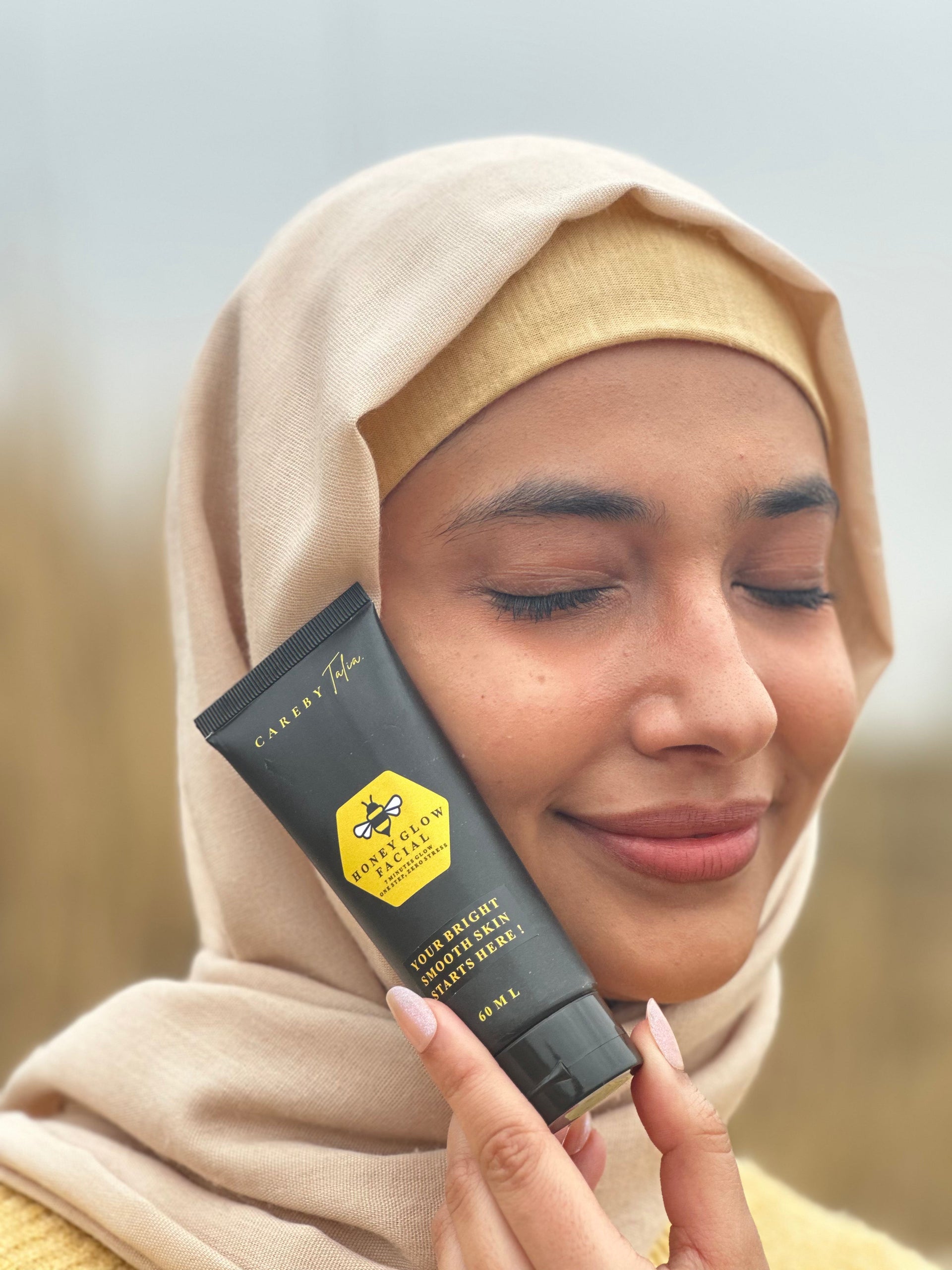
Honey Glow Facial — Enzymatic Exfoliating Mask
A 7-minute exfoliating mask formulated with Lactic Acid, Salicylic Acid, Honey, Aloe Vera, Hyaluronic Acid, and Panthenol (Vitamin B5). This is exfoliation done right — no walnut shells, no harsh scrubbing. It:
• Enzymatically dissolves dead skin cells for a smoother, brighter surface
• Deep cleans pores and visibly minimises them
• Removes tan and pollution-induced dullness
• Leaves skin soft and glowing from the first use
• Fragrance-free and suitable for sensitive skin
How to use: Apply evenly to the face, leave on for 7 minutes, then rinse gently. Visible results from the very first use.
Honey Glow Toning Mist — Brightening Essence Mist
Apply this to damp skin immediately after the facial. Formulated with Niacinamide, Licorice Extract, Honey, Aloe Vera, and Witch Hazel, it is the brightening and toning step in one spray. It:
• Fades uneven tone and dark patches with Niacinamide
• Targets UV-induced tan and hyperpigmentation with Licorice Extract
• Controls oil — ideal for Pakistan's humid weather
• Keeps skin hydrated without a heavy or sticky feel
• Tightens pores after exfoliation for a refined, glass skin finish
How to use: Mist onto damp skin right after rinsing the facial, and gently pat in. No rinsing needed.
Bundle Details
• Price: Rs. 2,650 (Regular Rs. 2,930 — 9% off)
• Cash on Delivery (COD) available across Pakistan
• Free shipping on orders above Rs. 2,500
• Delivery within 3–4 working days
Shop now: carebytalia.com — Glass Skin Bundle
Frequently Asked Questions
How long does it take to get glass skin?
Results in texture and immediate glow are visible after the very first use. With consistent use two to three times per week, significant improvement in even tone and refined texture is typically visible within three to four weeks.
Does this work for oily skin?
Yes. The Honey Glow Facial contains salicylic acid that deep cleans oily pores. The Toning Mist controls oil without stripping the skin. Both products are suited to Pakistan's humid summers and oily or combination skin types.
Can people with sensitive skin use this?
Both products are formulated with sensitive skin in mind. The Honey Glow Facial is fragrance-free. Always do a patch test before full application if your skin is reactive.
Is this a safe alternative to bleach?
Completely. Rather than using harsh chemicals that damage the skin barrier, this bundle uses clinically backed brightening ingredients — Niacinamide and Licorice Extract — that gently and effectively address uneven tone without the side effects of bleach or mercury-containing creams.
Do I still need SPF?
Yes, and this is non-negotiable for Pakistani skin. Any brightening routine without SPF is an uphill battle. UV exposure will undo the results you are working toward. Apply a broad-spectrum SPF every morning as the final step of your morning routine.
The Bottom Line
Glass skin is not out of reach for Pakistani skin — it just requires the right approach. Harsh chemicals, walnut scrubs, and bleach creams can offer a short-term change, but they compromise your skin's long-term health and make the problem worse over time.
The real formula is gentle exfoliation, barrier-friendly brightening, and consistent SPF. The Care By Talia Glass Skin Bundle is built on exactly this philosophy — formulated for Pakistani skin, Pakistani weather, and the specific concerns that come with it.
Try it, see the results. COD available — order first, pay on delivery.
Published by Care By Talia | carebytalia.com | contact@carebytalia.com
About Author

Etiam vel magna sed leo feugiat cursus. Cras mollis blandit dolor. Praesent vulputate justo quis volutpat pharetra. Suspendisse
Recent Post


Tags


